
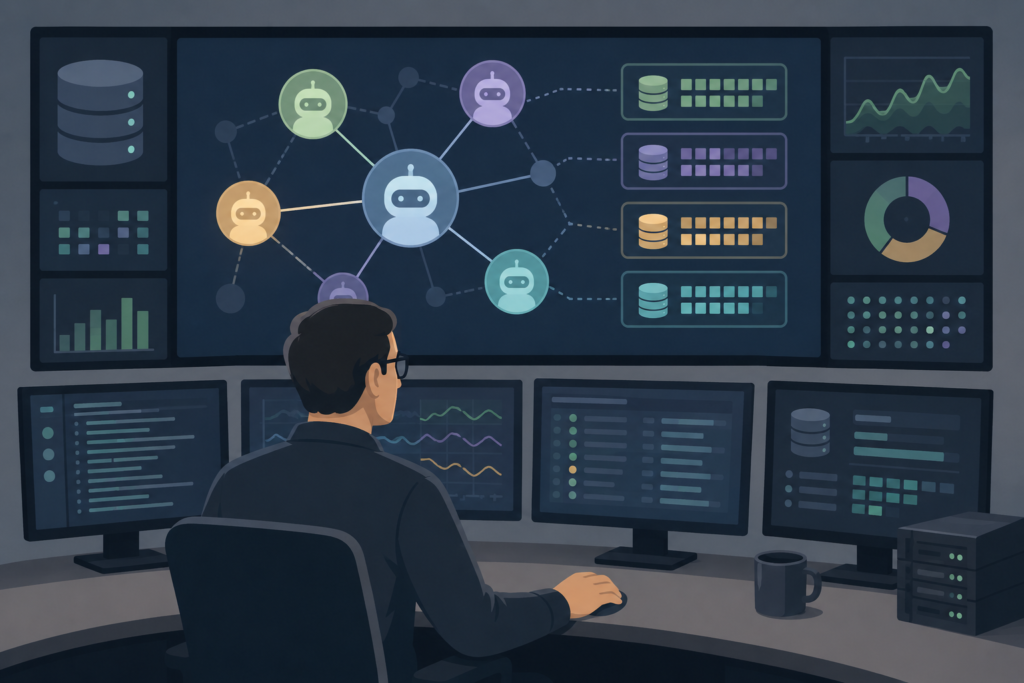
A junior DBA on my team asked me last week what she should be studying next. My honest answer surprised her: not another indexing course. Agent governance — the new discipline the Oracle agentic AI database shift just made unavoidable.
That’s not a sentence I expected to say two years ago. But Oracle’s agentic AI push into AI Database 26ai isn’t a feature release — it’s a quiet redefinition of what a DBA is responsible for. Most of what I’ve seen written about it so far is still a features list.
The old job, the new job
For most of my 20 years, the job looked like this: storage, RMAN, indexes, execution plans, undo, locks. Predictable failure modes. You could learn the shape of every incident in advance.
Oracle’s March 2026 announcements added two capabilities that don’t fit that shape at all: Oracle AI Agent Memory, a persistent memory layer built on Oracle AI Database that gives agents stateful memory across sessions, and the Oracle AI Database Private Agent Factory, a no-code platform for building, deploying, and managing agents that run close to your Oracle data.
Read that again slowly. Persistent memory, built directly on the database you already run in production.
That’s not a new SQL feature to learn. That’s a new category of thing operating on your box, and the industry hasn’t had time to standardize the operational playbook for it yet.
Every demo looks amazing. Production is where this breaks.
A demo agent answers one question against one clean dataset and everyone applauds. Production is ten thousand concurrent sessions, a compliance audit, a 2 AM page, and a security team asking who approved this agent’s access.
That gap is where the real work of this job shift lives. Two places it shows up first:
1. Agent governance — the new blast radius problem
An agent running against your production data isn’t a read-only chatbot. It can be granted privileges to reason over live data and take action. The question every DBA needs an answer to before this goes to production: what’s the actual blast radius if an agent’s reasoning goes wrong, or it’s manipulated through flawed prompts or unexpected reasoning into doing something it shouldn’t?
RBAC and row-level security don’t disappear — Oracle’s SQL Firewall still governs SQL traffic. But “who can query this table” was always a simpler question than “what can an autonomous process decide to do with this table, unsupervised, at 2 AM.” That’s a governance model most DBA teams haven’t built yet, because there was nothing to govern before.
2. Persistent agent memory — the capacity and backup problem most teams haven’t planned for
Stateful agent memory means something new is accumulating on the Oracle AI Database platform that isn’t a table you designed. It has a growth rate. It has a retention question. Further, It needs a backup and recovery story like everything else that lives in your CDB — except right now, most teams don’t even know it’s there to plan for.
Storage growth from agent memory doesn’t show up in a capacity forecast built for transactional tables. Neither does “how long do we retain what an agent remembers, and does that intersect with a data-retention policy we already signed.”
What this actually means for the job
The database didn’t disappear behind the AI hype. It absorbed the AI. Storage didn’t disappear. Indexes didn’t disappear. RMAN didn’t disappear. What happened instead: the operational surface area of the DBA expanded to include supervising what now runs autonomously inside the system you’re already responsible for.
Concretely, that means treating every agent deployed through the Private Agent Factory the way you’d treat a new application onboarding to production: privilege review before go-live, a monitoring plan for its memory footprint, and an incident-response answer for “what do we do if this thing does something we didn’t expect.”
Most organizations will still need to define their own operational standards around governance, monitoring, retention, and incident response for this — the same way we built discipline around connection pool leaks and abandoned transactions, except this time, ideally before the first incident, not after.
The honest verdict
This is a genuine architectural shift, not marketing dressed up as one — Oracle’s own announcements confirm persistent agent memory and no-code agent deployment are now first-class capabilities built on Oracle AI Database. What I won’t claim is that the operational playbook has caught up to the technology. The technology arrived first; most enterprise teams are still writing their first runbook for it.
If you’re running Oracle in production and haven’t yet asked “what governs an agent with memory built on my database” — that’s the study list before the next incident writes it for you. If you’re just getting your hands dirty with the platform side of this, our walkthrough on Select AI: Talking to Your Database in Plain English is a good next stop, and if you want the version-history context behind “26ai,” see Oracle AI Database 26ai Version Numbering, Explained.
The Oracle agentic AI database shift isn’t a reason to panic — it’s a reason to get ahead of the runbook before an incident forces you to write it under pressure.
What’s your team’s plan for agent governance? Genuinely curious what other production shops are doing here — drop it in the comments.