
By Sanjeeva Kumar | Senior Oracle DBA | Oracle ACE Apprentice | dbadataverse.com
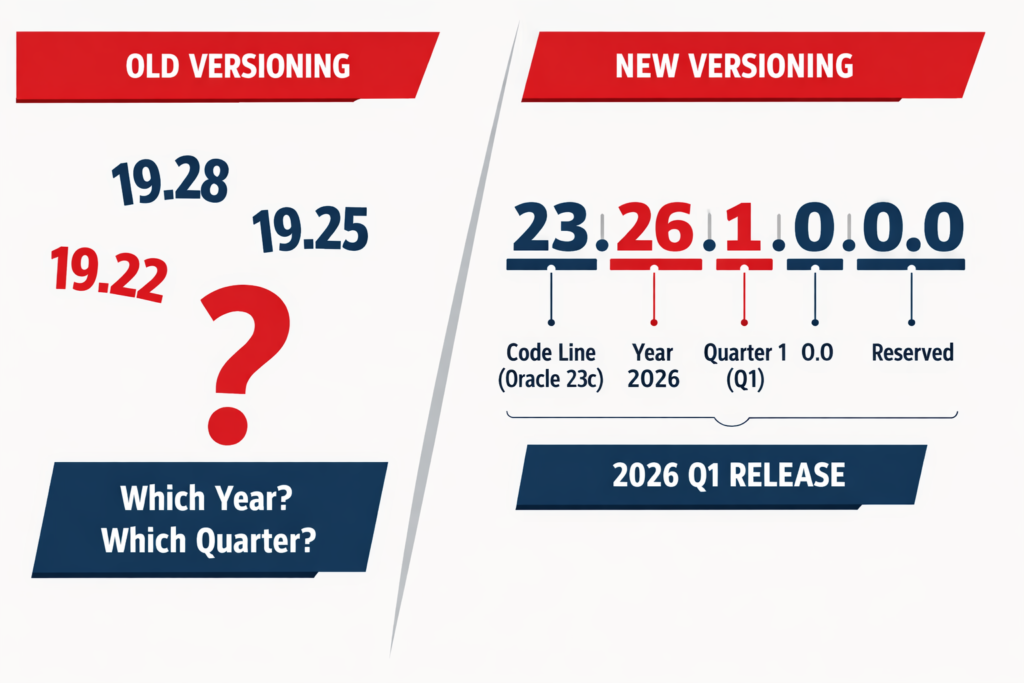
Have you ever looked at an Oracle version string and struggled to figure out exactly when it was released? You are not alone. Recently, while reviewing patch compliance across our Oracle 19c production environments, a colleague asked a simple question — “Are we current on patching?” I knew we were on 19.28, but pinning down the release quarter required a My Oracle Support lookup. That moment captures precisely why Oracle decided to rethink version numbering.
With the arrival of Oracle AI Database 26ai, Oracle has introduced a calendar-year based version numbering system. The first on-premises GA release carries the version string 23.26.1.0.0 — and if that looks unfamiliar, this post will break it down completely. Let’s dive in step-by-step.
1. Why Oracle Changed the Version Numbering
To appreciate the new system, we need to be honest about what was frustrating with the old one.
Most of us are running Oracle 19c in production today. Oracle delivers quarterly patches called Release Updates (RUs). As of early 2026, Our Oracle 19c is at 19.28.
Here is the honest problem. When someone says “I am on 19.28”, can you immediately tell:
- Which year that release update belongs to?
- Was it released in Q1 or Q3?
- Is it from 2024 or 2025?
The answer is no — not without cross-referencing My Oracle Support. The version string alone carries zero calendar context. For DBAs managing large estates, compliance teams producing audit evidence, and architects planning upgrade roadmaps, this ambiguity has been a genuine operational pain point for years.
Oracle has now addressed this directly with a cleaner, time-aware versioning model.
2. Understanding the New Format — 23.26.1.0.0 Explained
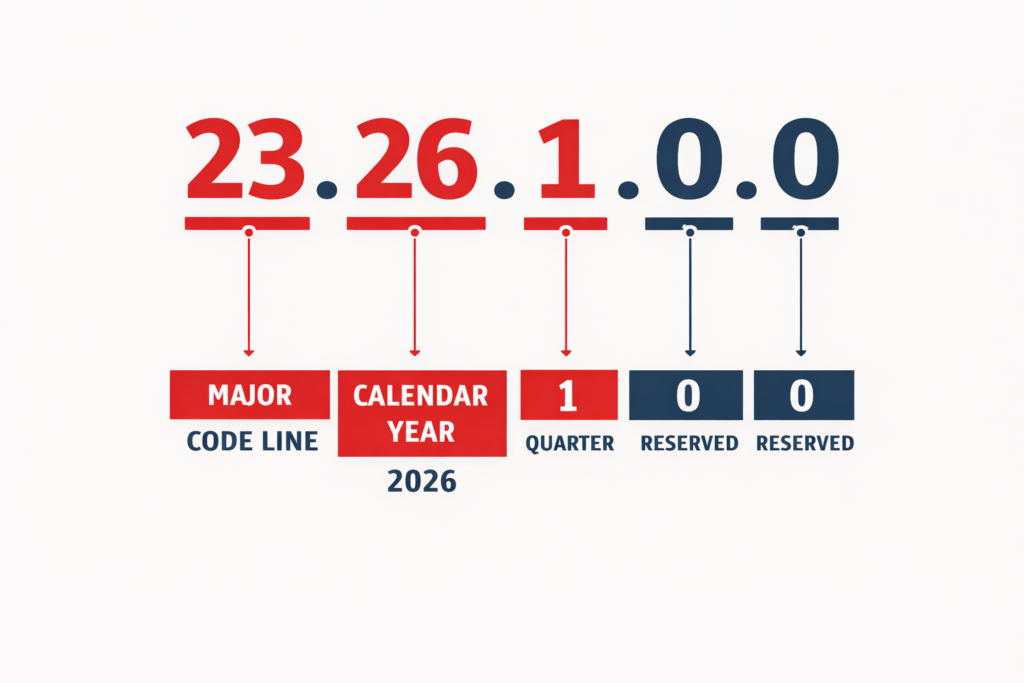
The new version format follows this five-part structure:
23 . YY . Q . 0 . 0
Let’s break down each segment clearly:
| Segment | Example Value | Meaning |
|---|---|---|
| 23 | 23 | Oracle 23 code line — the database generation |
| YY | 26 | Calendar year of the release update — 2026 |
| Q | 1 | Quarter of the release update — Q1 (January) |
| 0 | 0 | Reserved — always 0 |
| 0 | 0 | Reserved — always 0 |
So 23.26.1.0.0 reads as: “Q1 2026 release update of the Oracle 23 code line.”
The forward sequence looks like this:
| Version | Quarter | Month |
|---|---|---|
| 23.26.1.0.0 | Q1 2026 | January 2026 — GA Released |
| 23.26.2.0.0 | Q2 2026 | April 2026 |
| 23.26.3.0.0 | Q3 2026 | July 2026 |
| 23.26.4.0.0 | Q4 2026 | October 2026 |
| 23.27.1.0.0 | Q1 2027 | January 2027 |
What I find particularly useful about this is how self-documenting it becomes. When a colleague says “we are on 23.26.2.0.0”, you immediately know that is the Q2 patch of 2026 — no lookup required. That is a genuinely practical improvement for our day-to-day patch management work.
3. What Exactly Is Oracle AI Database 26ai?
This is where precision matters, so let me state it clearly.
Oracle AI Database 26ai is built on the Oracle 23c code line and continues the internal 23.x version numbering. The product name “26ai” is not simply a marketing rebrand — it reflects Oracle’s annual innovation release cadence model introduced with Oracle 23c.
Here is the key distinction. Oracle 23c established the foundation and was progressively enhanced through cloud-first release updates — 23ai being the AI-enriched milestone of that journey. Each year’s release update cycle now advances the product brand to reflect the current year. So in 2026, the brand becomes Oracle AI Database 26ai, while the internal code line remains 23.x.
A useful way to think about it:
23 = the code line that underpins the database
26ai = the current year’s product identity and innovation milestone
The two are not in conflict — they are two different ways of describing the same product at different levels of technical detail. Internally you will always see 23.26.x in V$VERSION. Externally, Oracle is positioning this as the 2026 AI-era iteration of the platform.
4. How This Fits Oracle’s Annual Innovation Release Cadence
Oracle’s shift to calendar-year versioning is not an isolated decision — it is part of a broader strategic alignment.
Many Oracle Cloud platform and infrastructure services have followed a time-aware versioning philosophy for years. By introducing this model at the database engine level, Oracle is building consistency across how release currency is communicated — whether you are managing a cloud-managed service or an on-premises deployment.
More importantly, this cadence signals that Oracle intends to keep the 23 code line as a long-term evolving platform, with each calendar year bringing a fresh wave of capabilities under a recognisable brand. In our experience managing Oracle estates across different environments, having version numbers that self-document their release timeline is an underappreciated but meaningful operational improvement.
5. Oracle 26ai Is Now GA On-Premises — What You Need to Know
Here is the milestone the on-premises Oracle DBA community had been waiting for.
Oracle AI Database 26ai Enterprise Edition for Linux x86-64 is now generally available for on-premises deployment. The GA release was confirmed on January 27, 2026, under version 23.26.1.0.0.
A few important points of precision here:
This is not the first ever on-premises Oracle 23 release. Oracle 23c was available earlier in specific contexts, and cloud-managed versions of Oracle 23ai have been available on OCI, Azure, Google Cloud, AWS, and Oracle Engineered Systems for some time. What January 27, 2026 marks is the first Oracle AI Database 26ai-branded on-premises GA release for standard Linux x86-64 deployments — bringing the full 26ai feature set to customer data centres for the first time.
Migration path from Oracle 23ai cloud or engineered systems: If you are already running Oracle 23ai on OCI, an Oracle Engineered System, or a cloud-managed platform, the transition to 26ai is straightforward — simply apply the January 2026 Release Update (23.26.1.0.0). No full database upgrade, no application re-certification, and no data migration is required. This is a patch-level operation.
Other platforms: Windows, AIX, and other platforms are scheduled for release across the remainder of 2026.
You can download Oracle AI Database 26ai today from the Oracle Software Delivery Cloud or oracle.com. Search for “Oracle AI Database 26ai” — you will download version 23.26.1.0.0.
Licensing Note: Oracle AI Database 26ai is available as a free download for development and learning purposes under Oracle’s free developer licence terms. Production use requires an active Oracle Database licence. Always review the applicable Oracle Technology Network (OTN) licence agreement before deployment.
6. What About Oracle 19c?
The new calendar-year versioning system applies going forward from the Oracle 23 code line only. Oracle 19c continues with its traditional RU numbering — 19.28, 19.29, and so on — under its existing support lifecycle.
For those planning upgrade roadmaps, the recommended path is a direct upgrade from Oracle 19c to Oracle AI Database 26ai (23.26.1.0.0). Oracle supports this direct upgrade path and provides AutoUpgrade tooling to simplify the process.
7. Quick Reference — Old vs New Versioning
| Format | Example | What It Tells You |
|---|---|---|
| Old (19c) | 19.28.0.0.0 | 19c, 28th RU — calendar context requires lookup |
| New (26ai) | 23.26.1.0.0 | 23 code line, Year 2026, Q1 — instantly readable |
| New (26ai) | 23.26.2.0.0 | 23 code line, Year 2026, Q2 |
| New (26ai) | 23.27.1.0.0 | 23 code line, Year 2027, Q1 |
8. What This Means for You as a DBA
Here are the practical takeaways from this versioning change that matter for our day-to-day work:
- Patch tracking becomes self-documenting. The version string tells you the year and quarter of any release update — no My Oracle Support cross-reference required.
- Compliance and audit evidence improves. Version numbers now carry calendar context, making patch currency easier to demonstrate to auditors and security teams.
- Upgrade planning is unambiguous. If you are on Oracle 19c today, your next major target is 23.26.1.0.0 — the first on-premises GA release of Oracle AI Database 26ai.
- If you are on Oracle 23ai (cloud or engineered systems), moving to 26ai is simply applying the January 2026 RU — a well-understood patch operation.
- Cross-environment consistency improves. Managing Oracle estates across on-premises and cloud becomes clearer when version currency is expressed in a common calendar-aware language.
9. Frequently Asked Questions (FAQ)
Q: Is Oracle AI Database 26ai a completely new database engine? No. Oracle AI Database 26ai is built on the Oracle 23c code line and uses 23.x internal version numbering. The “26ai” branding reflects Oracle’s annual innovation release cadence for the 2026 cycle — not a new major version or code line.
Q: What does 23.26.1.0.0 mean? It means the Q1 2026 release update of the Oracle 23 code line. The segments are: 23 (code line), 26 (year 2026), 1 (quarter 1), and two reserved zeros.
Q: I am on Oracle 23ai on OCI. Do I need a full upgrade to move to 26ai? No. If you are running Oracle 23ai on OCI, an Oracle Engineered System, or a cloud-managed platform, transitioning to 26ai requires only applying the January 2026 Release Update (23.26.1.0.0). No upgrade or re-certification is needed.
Q: Will Oracle 19c follow the same versioning system? No. Oracle 19c continues with its traditional version numbering (19.28, 19.29, etc.) under its existing support lifecycle.
Q: Is Oracle AI Database 26ai free to download? Oracle AI Database 26ai is available as a free download for development and learning purposes under Oracle’s developer licence terms. Production deployment requires an active Oracle Database licence. Review the OTN licence agreement at oracle.com before use.
Q: Is this the first time Oracle 23 has been available on-premises? Not entirely. Oracle 23c existed in earlier limited forms. January 27, 2026 marks the first Oracle AI Database 26ai-branded on-premises GA release for Linux x86-64 — making the full 26ai feature set available to standard customer data centre deployments for the first time.
Conclusion
Oracle’s calendar-year versioning system is a meaningful and welcome evolution for our community. The old format left us guessing about patch currency. The new format — 23.26.1.0.0, 23.26.2.0.0, 23.27.1.0.0 — makes it immediately clear when each release update was published and in which quarter. No lookup required.
More broadly, this change reflects Oracle’s vision of the 23 code line as a long-term, annually evolving platform — with Oracle AI Database 26ai representing the 2026 milestone of that journey. For on-premises DBAs who have been waiting to evaluate this platform in their own data centres, the wait ended on January 27, 2026.
Whether you are planning your next upgrade from Oracle 19c or already running Oracle 23ai and looking to apply the January 2026 RU, understanding this version numbering model is the right place to start. Let’s explore it together.
Have questions about Oracle AI Database 26ai or your upgrade planning? Drop them in the comments below or connect with me on LinkedIn — I would love to hear how you are approaching this in your own environment.
Related Articles:
- How to Configure Oracle Listener for Standalone Database: Step-by-Step Guide
- Oracle Database Memory Monitoring Guide
- Oracle ASM 19c Installation: Complete Guide to Oracle Restart Grid Infrastructure
- Response file for Oracle ASM Standalone Oracle 19c
1 thought on “Oracle 26 AI Version Numbering: What Does 23.26.1.0.0 Actually Mean?”