
Last Updated: May 2026 | Tested On: PostgreSQL 16.1, pgvector 0.8.1 | Author: Sanjeeva Kumar, Oracle ACE Associate
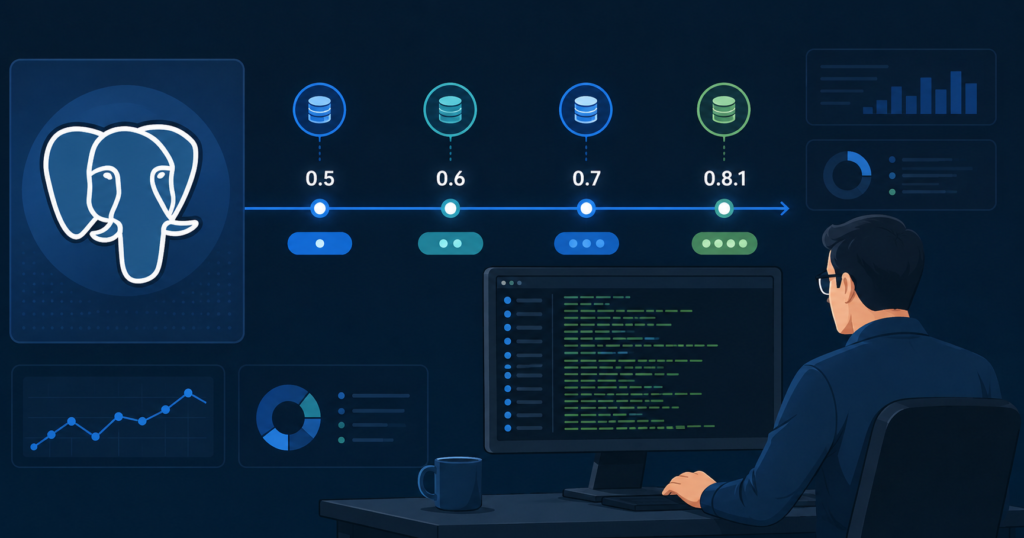
If you landed here searching “pgvector updates 2026” — you’re not looking for a setup tutorial. You already have pgvector running, or you’re evaluating it, and you want to know: what changed, what broke, and is it safe to upgrade in production?
That’s exactly what this post covers. I maintain this as a living document. Every time pgvector ships a meaningful release, I update this with a DBA’s take — not marketing copy.
Quick Version Reference
| Version | PostgreSQL Support | Key Change | General Stability |
|---|---|---|---|
| 0.8.1 | 12–17* | HNSW performance, sparsevec stable | Widely Adopted |
| 0.8.0 | 12–17* | Sparse vector support (sparsevec) | Widely Adopted |
| 0.7.x | 12–16 | Iterative index scans | Mature |
| 0.6.x | 12–16 | HNSW index introduced | Mature |
| 0.5.x | 11–15 | IVFFlat only era | Stable, Superseded |
*At the time of writing (May 2026), pgvector 0.8.x supports PostgreSQL 12–17 based on current upstream compatibility. Always verify against the official pgvector releases page before upgrading — compatibility can change with minor releases.
Stability ratings reflect community adoption patterns only. Validate any version against your specific PostgreSQL version, OS, and workload before production deployment.
How to Check Your Current pgvector Version
Before anything else — know what you’re running:
sql
SELECT extversion FROM pg_extension WHERE extname = 'vector';Expected output:
 extversion
------------
 0.8.1
Cross-reference with the installed OS package:
bash
# RHEL/Rocky Linux
rpm -qa | grep pgvector

# Ubuntu/Debian
dpkg -l | grep pgvector
Expected output (RHEL):
pgvector_16-0.8.1-1.rhel9.x86_64If the package version and pg_extension version do not match, you installed the package but did not run ALTER EXTENSION inside the database. Fix it:
sql
ALTER EXTENSION vector UPDATE;
SELECT extversion FROM pg_extension WHERE extname = 'vector';
pgvector 0.8.1 — What Actually Changed
Released: Late 2025 | Tested by this author on: PostgreSQL 16.1, RHEL 9
HNSW ef_search Default Raised to 40
Previous default was lower. If you upgraded from 0.7.x without touching your config, recall improves automatically — but query latency increases slightly under load.
Check your current setting:
sql
SHOW hnsw.ef_search;Expected output:
 hnsw.ef_search
----------------
 40
If you need to tune it back for latency-sensitive workloads:
sql
-- Per session (does not persist across reconnections)
SET hnsw.ef_search = 20;

-- Verify
SHOW hnsw.ef_search;
My take: keep ef_search at 40 unless you are hitting latency SLAs below 20ms on high-concurrency workloads. The recall improvement is measurable and for most enterprise DBA use cases, correctness matters more than shaving milliseconds.
Sparse Vector Type: sparsevec
The headline feature of 0.8.0, stabilized in 0.8.1. Stores only non-zero dimensions — useful for BM25 or SPLADE embeddings where most values are zero.
Check if your installed version supports it:
sql
SELECT typname FROM pg_type WHERE typname = 'sparsevec';Expected output on 0.8.1:
  typname
-----------
 sparsevec
Zero rows returned means you are on 0.7.x or earlier.
Should you use sparsevec? Only if you are running hybrid search combining dense and sparse embeddings. For standard OpenAI, Sentence Transformer, or Nomic embeddings, stick with the standard vector type. I cover this in detail in the pgvector complete guide.
Upgrading pgvector in Production: The Right Approach
I have seen teams drop and recreate the extension thinking that is the clean path. Do not. You lose your indexes. On a table with millions of vectors, rebuilding HNSW indexes means hours of downtime.
Here is the safe sequence.
Step 1 — Verify current version and PostgreSQL compatibility
sql
-- Check running version
SELECT extversion FROM pg_extension WHERE extname = 'vector';

-- Check PostgreSQL version
SELECT version();
Cross-check your PostgreSQL major version against the compatibility table above before proceeding.
Step 2 — Update the OS package
bash
# RHEL/Rocky Linux
sudo dnf update pgvector_16

# Ubuntu/Debian
sudo apt update && sudo apt upgrade postgresql-16-pgvector
Step 3 — Restart PostgreSQL
A full restart is required after a package upgrade — not a reload.
bash
sudo systemctl restart postgresql-16Why restart and not reload? A reload only re-reads configuration files. When the pgvector shared object library (vector.so) is replaced on disk by the package upgrade, existing backend sessions continue using the old library until they reconnect or the postmaster restarts. In environments with PgBouncer, long-running sessions, or persistent connection pools, a reload leaves a mixed state where some backends run the new binary and some run the old one. A clean restart eliminates that ambiguity entirely.
If you are running a high-availability environment with active OLTP load, drain connections first or schedule a brief maintenance window before restarting.
Step 4 — Run ALTER EXTENSION inside every database using pgvector
sql
-- Connect to each database that has pgvector enabled and run:
ALTER EXTENSION vector UPDATE;

-- Verify
SELECT extversion FROM pg_extension WHERE extname = 'vector';
Expected output:
 extversion
------------
 0.8.1
This step is easy to miss in multi-database instances. If you have five databases with pgvector enabled, you need to run this in all five.
Step 5 — Verify your indexes are healthy
sql
SELECT indexname, indexdef
FROM pg_indexes
WHERE indexdef ILIKE '%hnsw%'
   OR indexdef ILIKE '%ivfflat%';
Then refresh statistics and run a test query:
sql
-- Refresh planner statistics first
ANALYZE your_table_with_vectors;

-- Run a test query and check the plan
EXPLAIN ANALYZE
SELECT id, content,
       embedding <=> '[0.1, 0.2, 0.3]'::vector(3) AS distance
-- Note: 3-dimension vector shown for readability only.
-- Your production embeddings will be 384 (MiniLM), 768 (Nomic),
-- 1024 (BGE), or 1536 (OpenAI text-embedding-3-small) dimensions.
FROM documents_test
ORDER BY distance
LIMIT 5;
Confirm “Index Scan” appears in the plan output, not “Seq Scan.”
If PostgreSQL Chooses a Sequential Scan After Upgrade
A sequential scan after upgrade is not automatically a problem. The planner makes cost-based decisions — it could reflect stale statistics, low row count, or cost estimation after library reload. Work through this sequence before reaching for REINDEX:
sql
-- Step 1: Refresh statistics
ANALYZE your_table_with_vectors;

-- Step 2: Check if sequential scans are being forced
SHOW enable_seqscan;

-- Step 3: Check actual row count
SELECT COUNT(*) FROM your_table_with_vectors;

-- Step 4: Review cost estimates the planner is using
EXPLAIN your_vector_query_here;

-- Step 5: Only if index corruption or invalidation is confirmed
REINDEX INDEX CONCURRENTLY your_embedding_idx;
In most cases Steps 1 and 4 resolve it. REINDEX is a last resort, not a first response.
Common “After Upgrade” Issues
“Function vector_out(sparsevec) does not exist”
Classic sign you upgraded the OS package but did not run ALTER EXTENSION vector UPDATE in one or more databases.
sql
-- Run in every database that has pgvector enabled
ALTER EXTENSION vector UPDATE;
ef_search behaving differently than expected
After upgrade, verify your GUC settings survived:
sql
SELECT name, setting, source
FROM pg_settings
WHERE name IN ('hnsw.ef_search', 'ivfflat.probes');
Session-level settings set with SET do not persist. Settings applied via postgresql.conf or ALTER SYSTEM persist across restarts — verify both are what you expect.
PostgreSQL Version Compatibility Matrix
| pgvector | PG 11 | PG 12 | PG 13 | PG 14 | PG 15 | PG 16 | PG 17 |
|---|---|---|---|---|---|---|---|
| 0.8.x | No | Yes | Yes | Yes | Yes | Yes | Yes* |
| 0.7.x | No | Yes | Yes | Yes | Yes | Yes | No |
| 0.6.x | No | Yes | Yes | Yes | Yes | Yes | No |
| 0.5.x | Yes | Yes | Yes | Yes | Yes | No | No |
*Compatibility based on upstream releases as of May 2026. Always verify current build availability for your OS and PostgreSQL combination at the pgvector releases page.
If you are still running PostgreSQL 11 for legacy reasons, pgvector version constraints are the least of your concerns — EOL risks and missing features in PG 11 are a bigger conversation.
What to Watch Going Forward
Rather than speculate on specific roadmap items, I track the pgvector GitHub releases page directly. The maintainers are active and ship detailed release notes. If you are doing capacity planning or evaluating pgvector for a major deployment, that page is your primary source of truth — not blog posts including this one.
I update this document quarterly. The version table and compatibility matrix above reflect May 2026 state.
Related Posts in This pgvector Series
This is Part 1 of the pgvector cluster on DBA Dataverse:
- Hub: pgvector Complete Guide — Installation, HNSW Tuning, Hybrid Search
- Part 2: pgvector vs Pinecone vs Weaviate — Production DBA’s Verdict (coming soon)
- Part 3: Install and Configure pgvector on PostgreSQL 16/17 — Step-by-Step (coming soon)
- Part 4: pgvector Gotchas — Dimension Mismatch, Casting, ALTER TABLE Solved (coming soon)
Questions about a specific version upgrade scenario? Drop it in the comments — I read every one.
3 thoughts on “pgvector Release Notes & Updates [2025–2026]: What Changed and What It Means for Your PostgreSQL Stack”